Otherwise, please select your country so we can show you products & currency for your location
The content of our website is always available in English and partly in other languages. Choose your preferred language and we will show you the content in that language, if available.
Fraction collection can be conducted in a variety of manners. Most commonly, however, fractions are collected either based on a simple function of time or more complex parameters set off by the signals from your detectors. Learn more in our helpful video, which highlights 8 common questions about fraction collection.
Preparative high performance chromatography (prep HPLC or LC) plays a crucial role in many industries. It is used to isolate and purify desired compounds, removing impurities and contaminants that can affect the quality and performance of the end product. In this video, we answer your questions about prep HPLC and how it can fit into your lab's purification workflows.
There are many different chromatography techniques, but which is right for your experiment? This video will give an overview of the main differences between analytical and preparative chromatography and help guide you to the technique that is best for your lab's purification research.
Peptides, or short chains of amino acids linked together by covalent bonds, are a growing class of pharmaceutical drugs. With a multitude of purification methods available for peptide purification, it’s possible to use several techniques together to enhance the purity of the peptide. This article covers the range of purification and detection methods used to purify peptides from process-related impurities and product-related impurities.
Post-extraction cleanup methods are commonly used in residue analysis workflows. The methods vary and the choice of method can depend on many circumstances: the type of sample, type of analyte, and regulatory requirements. This article focuses on two chromatography-based methods for post-extraction cleanup: gel permeation chromatography (GPC) and solid phase extraction (SPE).
Pharmaceutical peptides can be generated in a variety of ways. They can be generated by breaking down proteins to release peptides or they can be synthesized chemically, one amino acid at a time. This article covers synthetic peptide purification, focusing on purification by liquid chromatography-mass spectrometry (LC-MS).
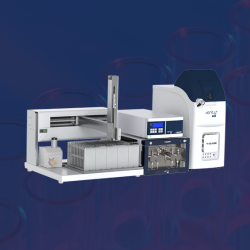
Sample preparation for any form of analysis can be tedious and time-consuming, and efforts to automate this process have been long and fruitful. Today, many different types of liquid handlers exist that can perform a variety of functions to increase throughput tremendously. In this application note, we demonstrate one example of sample prep by taking a common but complicated screening method for optimizing liquid-liquid chromatography run parameters and automating the process. We also showcase the use of liquid level detection in the precise liquid handling of biphasic solutions
In high performance liquid chromatography (HPLC), the selection of an appropriate mode of detection is vital to the success of any separation. To this end, there are numerous choices one might consider when configuring a new HPLC setup. Mass spectrometry (MS) is an alternative method of detection and identification that is much more robust than UV. Here, we describe how the VERITY 1920 Mass Spectrometer allows for MS detection capabilities at an affordable price for HPLC fraction collection.
Fractionation, or the separation of a mixture of molecules into different parts or “fractions,” helps scientists understand and/or use a complex solution. Collecting and isolating individual fractions from a mixture can enable many downstream applications as specific molecules can be separated based on physical and chemical properties. In this article, we explore the basics of fraction collection, including applications, parameters, and available solutions for your lab.
In this article, we provide an overview of GPC and how it’s used for post-extraction cleanup including: how GPC works, the components of a GPC system, and a step-by-step look into the GPC process